
Digging
***
Blackberry Picking
Continue reading “For the young lady and her love of Seamus Heaney”

I’ve seen him at the freeway entrance on my way home from work for a couple of weeks. His sign reads “Homeless, hungry, please help.” I carry cash in my car, but the timing has never worked out correctly for me to give him a little something.
It finally—barely—did. I waved him over, before the light changed, and gave him a couple of bucks. He smiled, said “God bless you”, and took the money. Then from the sidewalk he smiled again and again said “Bless you.” I smiled back.
There were maybe twenty cars lined up waiting to get onto the freeway, and I was the only one who reached out to this man and gave him money. I’m not judging them. Humans are a varied lot. And I’m not holding myself out as a paragon of virtue. As with most people, I have faults that t’would be better had my mother not borne me.
But, I’ve lived 46 years on this earth. And I’ve learned a few things. I’m not the same person I was 20 years ago. I would hope I wouldn’t be.
Many would see my act of charity as contributing to the problem. If you enable them, they won’t get the help they need. You’re just putting a band-aid on the problem. You’re just making things worse.
He could use the money to buy drugs. He could use the money to get drunk. Those are possibilities. I don’t know him.
But I don’t need to know him.

(Cross-posted on The Obama Diary.)
For the dead, we say, “Amen”. And for the living.
There are too many dead, and the living are riven.
Every day, a new horror, a new loss of innocence,
And the night-dimmed tide swallows us.
There is no innocence; this is a fallen world,
And men of evil revel in destruction.
When is it enough? It’s never enough.
Violence has an army of reasons,
And peace seems to be an idea
Honored more in the breach than the observance.
This is not your heritage; it is evil.
This is not your freedom; it is slavery.
Do that which you would have done unto you;
Flee from that which is harmful to all.
The answer is there, to be teased out
Of life, hard life, the only life we have.
Remember the dead, for they speak from the earth,
Pleading, “Let us not be in vain.”
In memory of the late great Mr. Coleman, a sample of him live.
Lonely Woman
Dancing in Your Head

As a librarian, I encounter all sorts of people, from the smugly self-satisfied to those barely clinging on. This is a story of the latter.
R. led a wonderful life. He was involved in baseball. He’s met presidents and celebrities. He flew around the world.
And now he’s losing his mind.
He doesn’t remember how to do the simplest things, things which he used to do with no help. For example, he will type a letter at home on his laptop, put it on his thumb drive, bring it to the library, and print it out.
However, for the past 2 weeks he’s been bringing in his laptop. Why? Because he no longer remembers how to transfer a file from the laptop to the memory stick. He needs help doing that every time. And then, once he’s on one of our computers so that he can print it out, he needs help on how to bring up the document. He used to do all these things without our assistance.
I’ve seen photos of him with Ronald Reagan, Bob Hope, the Three Stooges. He milled around with the great and good. And now he scrapes by with enough money to pay his rent and buy bologna. I’ve had to loan him a few bucks on a couple of occasions because he didn’t have enough gas in the tank to get him home. And now, senescence is creeping in. His memory is shot.
 The New Yorker, 2010, photo of Caraid O’Brien, who performs Molly Bloom’s Soliloquy every Bloomsday. http://www.newyorker.com/books/page-turner/1000-words-molly-bloom
Your afternoon / evening moment of beauty: the “Penelope” episode of “Ulysses”, aka Molly Bloom’s Soliloquy.
Bliss out, friends.

So of course I make my return to blogging on Bloomsday.
For those who don’t know what “Bloomsday” is: June 16, 1904, the date on which the story of James Joyce’s “Ulysses” takes place, starting with plump Buck Mulligan having his morning shave and ending with Molly Bloom’s mind unfolding in wonderful, ecstatic language. In between, the main protagonists—Stephen Daedalus and Leopold Bloom—crisscross Dublin, missing each other, until near the end they come together, our 20th century Odysseus and Telemachus.
In high school I read “Dubliners” and “A Portrait of the Artist as a Young Man”. I held off on “Ulysses” until I took a seminar at UCLA. And then, I was hooked.
Think you’re escaping and run into yourself. Longest way round is the shortest way home.
“Ulysses” is nothing short of life. The life of people. The life of a city. The life of a nation. The life of history. There had been nothing in the Western canon like it before it, and, aside from “A la recherche du temps perdu”, nothing like it since. (“Gravity’s Rainbow” comes close, but Joyce still pips Pynchon.) It is a meditation on history, destiny, the lies we tell ourselves, the lies we tell each other. It is a story of outsiders in a world made up of outsiders. (Even the people who think they are of the elect are in fact as exiled as the rest of us.) It is a story about finding your way home, or at least finding the beginning of the path towards home. It is a love story: of a love for humanity, and of a love for that other person without whom you cannot live. Its comedy is of the sort found in just living life. Its tragedy is of the same type. Continue reading “Bloomsday”

Good morning/afternoon, you wonderful internet people.
Today we have another chapter from my work in progress, The Genealogies. As always, comments are welcome.
***
Every Sunday right before July 20th—or July 20th itself if it fortuitously fell on a Sunday—Marcelo and Carlos and Lexie would gather at Mamá’s house early in the morning. They would all bundle into one car and drive the few blocks to her church. There was always a debate as to who would drive. As Lexie usually had the worst car, she mercifully was excluded. Carlos preferred larger SUV’s, so the family normally decided on his car, which he took with a resigned equanimity, being used, as the oldest child, to doing the yeoman’s work in the family. Marcelo never understood why there was such a hubbub every year. Oftentimes he would offer to drive, just to keep peace; their mother, however—who had never owned a car nor in fact had ever learned how to drive—always preferred going in Carlos’ truck, both for the roominess, and because customarily he drove slowly and carefully when she was in the car, figuring that the path of least resistance led to Paradise, or at least to calm with Mamá. Marcelo, also customarily, though he never drove more speedily than normal, also never changed his driving habits simply because one person or the other was in his car. This included Mamá.
“You’re going to give me a thrombosis,” she would say almost always when she would get into the car with him. Marcelo would meet that with the frustrated grunt and the eye-roll he had perfected as a teenager.
On that day, or near about it, they had their yearly appointment to hear a Mass for the dead. Every year Mamá would arrange for Papá’s name to be mentioned in the Spanish 10 a.m. Mass when the priest asked the congregation to remember the recently and not-so-recently departed, dear or otherwise. Carlos—father, ex-husband, all-around decent fellow despite his torture of Marcelo when younger—would bow his tall, slightly stooped frame when that portion of the Mass would arrive—not so much out of religious conviction, but out of filial duty. Lexie always glanced discretely at Mamá to make sure that her eyes were cast down, and then allow her gaze to wander, taking in the parishioners, some dressed in Sunday finery, others in backwards baseball caps and shorts reaching down below their knees. Mamá would let out a phantom sob at the point in the Mass when the priest read Papá’s name. Marcelo would stare straight ahead throughout most of the service, normally not glancing left or right, his eyes fixed on the priest, the altar-servers (no longer altar boys as they had been as recently as his youth, no, girls could now serve the Mass, which, while he considered it to be commendable, he also considered it to miss the broader point of sexual politics in the Church) the altar, the looming, bloody crucifix that seemed to always exude a pain and suffering that taunted the worshipper, diminishing him or her to the kind of insignificance one sometimes feels upon considering the vastness of the universe and the paucity of the self. That morbid iconography always left an impression on him that nothing anyone ever did would quite measure up to that sacrifice on a gnarled tree, and he resented the fruitlessness it suggested. Of course, that was the point, wasn’t it? He had concluded that any religion which posited that salvation was available only through adherence to a beaten and bloodied figure was not one for him. Yet, every year, there he would be, in the pew, kneeling, sitting, standing, genuflecting, even going up to receive the Host. As with his driving, it was a hard-wired habit.
A bit of jazz legend Oscar Peterson to take you into the last of your day.
***
C Jam Blues
***
Live at Ronnie Scott’s
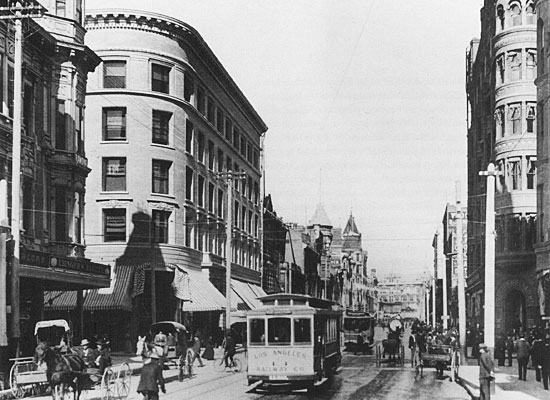
Another entry in my Fables and Dramas series. Another of my fables: “Tall Buildings”
***
A denizen of one of the bigger east-coast cities, or, indeed, of any teeming city in any part of the world not of the pristine and historically unmoored American West would no doubt be perplexed to come upon a news site that had an item which was titled “Man jumps from 12th floor in Los Angeles.” “Twelfth floor?” this putative surfer would no doubt sputter. “Really? They build buildings that big out there? Won’t they crash like stacked soda cans when the Big One ™ hits?” To which, of course, the jumper could give the finger in the infinite moment before his body hit the pavement, and perhaps unfortunate and inattentive passers-by.
I know this from experience. Los Angeles does indeed have many 12-story buildings—many buildings much greater than 12 stories, even! No, they’re not all compacted together, like glass and steel and stone blades of grass sprouting from a small plot of soil. No, in L.A. they have room to breathe, expanding outward as they rise upward, giving their tenants views of mountains and oceans (smog permitting), not of neighbors across the alley in adjacent buildings. L.A. is truly the city of the present and the future—and even the past, of drama and fable and fable. Look at the wide boulevards, look at the arching freeway superstructures, look at the little architectural gems littering the landscape, plopped down by someone with money and imagination. Oh, I tell you, this is the place to be. No place like it, no sir. This is how America will look, eventually: jumbled, polyglot, the past plowed under for the present and recalled—if worthy of being recalled—as myth.
 A Writing Corner